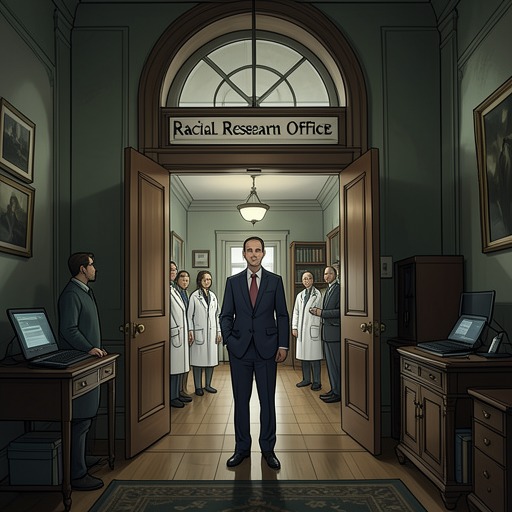
Heydrich inspects the biometric research center
The Glass RoomHeydrich inspects the biometric research center in Město at eleven in the morning, arriving with the authority of the Reich Protector and demanding to see the work rather than hear its justification. The visit brings the center’s central contradiction into sharp view: its staff present the examination of human beings as precise, confidential science, while the institution organizes bodies and personal histories into racial categories for a Nazi regime. Heydrich presses for a usable racial diagnosis, yet when the apparatus turns toward him, he takes control of the record and orders his measurements erased.
An inspection arranged under pressure
The center receives word that Reinhard Heydrich will visit, and uncertainty about the itinerary gives way to an official order: the premises must be ready at eleven, with the whole staff assembled. The convoy arrives exactly on time. Heydrich appears in a dark green Mercedes convertible bearing the Hakenkreuz and the number plate SS–3, a visible ranking that the narrative places beneath Adolf Hitler’s SS–1 and Heinrich Himmler’s SS–2. The staff greet him with the Nazi salute. Stahl begins a formal welcome, but Heydrich cuts off the speech: he wants to see what the researchers do, not listen to what they think about his visit.
The inspection proceeds ahead of schedule. As Heydrich and Stahl descend toward the Glass Room, Heydrich asks what kind of building houses the center. Stahl tells him it had been a private home. Heydrich asks whether its residents were Jews; Stahl says that he believes they were. The questions make the confiscated domestic setting part of the inspection itself: the research center occupies a house from which its former Jewish owners have emigrated, and the visitor regards that displacement as a detail to be assessed alongside the institution’s scientific work.
A system for making people legible
The center’s procedures give its claims of neutrality a carefully ordered physical form. Subjects arrive in groups of no more than a dozen, separated by sex and roughly by age, and are directed politely into the Glass Room. Staff explain that they are scientists and should treat human subjects with the respect zoologists owe animals. The examination begins with a form recording birth date and place, languages, religion, race, and nation, as well as illnesses and conditions in a subject’s ancestry, including alcoholism, criminality, and intellectual disability. The information is declared confidential and collected in the name of pure science.
From the forms, subjects move to cognitive tests involving shapes, sequences, and patterns, then change into medical gowns for blood-group tests and blood-pressure measurements. In the measurement rooms, staff work in pairs: one examiner positions the subject while a recorder waits with a pen. The process requires exact posture against a stadiometer’s backboard, with the head held and the chin level. Height, hip and chest diameters, limbs, and cranial dimensions are recorded; skin is compared with a von Luschan chromatic chart, and eyes with rows of model eyes. The examiner adjusts and cajoles each person until the standardized position is right. The reassurance that there will be no pain accompanies a process in which the subject’s body is made available to another person’s measuring gaze.
The narrative links this meticulous procedure to the design of the Glass Room: the measurements are presented as perfect as the room’s own dimensions. That resemblance makes precision feel less like proof of impartiality than like an aesthetic of control. The orderly space, forms, instruments, and paired staff give racial classification the appearance of an exact science, although the categories they record are already shaped by the regime’s assumptions.
Heydrich tests the center’s claims
On the stairs, Heydrich asks directly whether the research can identify Jews. Stahl describes work on hair colour, then cites diseases he associates with Jewish heredity, including Sachs’s infantile amaurotic idiocy, Canavan’s spongy degeneration of the brain, and Gaucher’s disease. But he qualifies the claim: not all Jews have these conditions, and not everyone with them is Jewish. The center’s method, he explains, is instead to measure small variations in phenotype and look for combinations that might support a racial diagnosis. Hollerith machines are to sort the accumulated data.
Heydrich’s questions expose what the researchers’ technical vocabulary serves. He is not satisfied with collecting measurements as an end in itself; he wants a distinction that can identify Jews, and he tells the scientists that the work is vital and should be hurried. He also extends the demand to Slavs, declaring some of them no less degenerate than Jews. The visit thus makes explicit the intended political direction of classification: measurements and data are expected to produce categories that can be put to use by the Nazi state.
Inside the Glass Room, Heydrich looks at its onyx wall, windows, and open space, and remarks that it resembles a fencing hall more than a living room. When told that the Landauers were very modern people, he asks what happened to them. Stahl answers that they emigrated. Heydrich calls this excellent and nods toward the scientists as if the family’s departure were their achievement. His response folds the history of expulsion into his inspection of the research facility without acknowledging the difference between the former residents and the institution that has replaced them.
The examiner becomes the examined
The piano left behind by the owners interrupts Heydrich’s tour. He asks why the center has kept it and whether Stahl plays. Stahl names Liszt and Beethoven, but not Mendelssohn, explaining that Mendelssohn was Jewish. Heydrich challenges the implication that Jewish identity makes the composer’s music worse and says that, had he brought his violin, they might have played Mendelssohn together. He then turns back to the measuring apparatus. The exchange briefly unsettles the expected script: the senior Nazi official questions an antisemitic judgment, but this moment does not displace his demand for research that will distinguish and rank racial groups.
Stahl, relieved by Heydrich’s interest in the methods, proposes that the Reich Protector be measured so that he can understand them directly. Heydrich agrees. Elfriede Lange guides him through the examination, indicating where to stand, sit, and lie down. The man who has demanded the measurement of others is now positioned on the couch beneath the center’s instruments, his boots and medals shining under the lights. He compliments Lange as being of fine Nordic stock, showing how the racial vocabulary circulates even within the examination room.
When Lange reaches the final cranial measurements, Heydrich catches her wrist and says that he will take his file as a souvenir. He also orders that no record of his measurements be kept. Lange complies, completing the task in fear. Heydrich leaves the encounter with the power to preserve the data gathered from other bodies while exempting himself from the archive. His command makes the limits of the center’s supposed objectivity unmistakable: measurement is not an impersonal rule imposed equally on everyone, but an instrument whose records remain subject to authority.
Numbers, records, and the politics of objectivity
The center’s monthly returns show the scale on which its classificatory work proceeds. Stahl reviews a report of 193 Roma processed by a Bratislava unit, ranging in age from thirteen to eighty-seven. The April figures list 672 people assessed: 316 classified as Slav, 239 as Aryan, and 112 as Mischlinge of various degrees; Roma and Jews appear separately in an addendum. These figures turn people into administrative totals, while the categories themselves reproduce a racial order that the institution presents as something to be discovered rather than imposed.
The records do not remain in the Glass Room. Punched cards are duplicated and boxed for a courier to Prague, then sent onward to Berlin, where machines sort, assemble, and analyze them at 150 cards a minute. The description’s promise that patterns and correlations will reveal the keys to race and identity sits beside the human handling that precedes it: forms, anxious faces, restrained bodies, and measurements taken by examiners who position their subjects. Machine speed does not remove the human and political choices embedded in the data; it extends their reach.
The inspection’s ending completes the contrast. Heydrich urges the staff to find an indisputable Jewish characteristic and pursue the same project for Slavs, while ensuring that his own file will not join their records. The institution’s claim to confidential, exact science is therefore paired with selective visibility: subjects are extensively documented, the Reich Protector controls what is kept about himself, and the resulting archive is prepared for analysis in Berlin. The scene presents scientific objectivity not as an innocent safeguard against prejudice but as a polished procedure through which racial ideology can acquire the authority of measurement.